
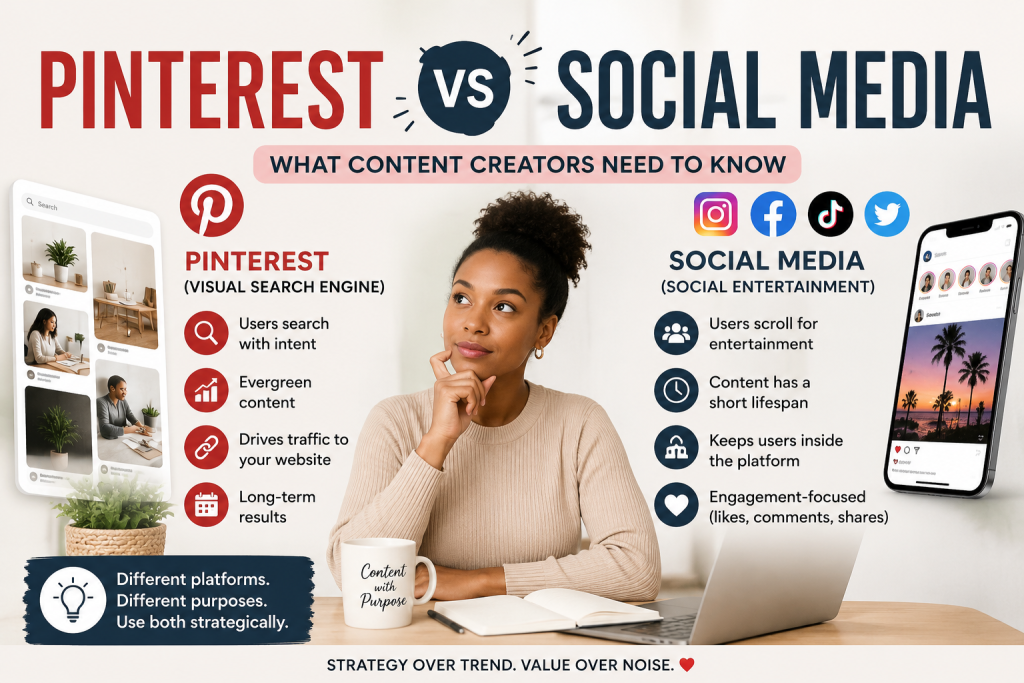
Many content creators treat Pinterest as an inspiration or ideas-sourcing platform.
They mostly go to the platform to get inspired for creative purposes. Pinterest goes beyond that; many debate whether Pinterest is a social media platform. The debate continues.
Although Pinterest has some social features like following accounts, saving pins, and sharing content, it is more accurate to describe Pinterest as a visual search engine rather than a social media platform.
Understanding this difference can completely change your content strategy as a creator.
In this article, you will learn:
- whether Pinterest is social media
- how Pinterest differs from social media
- why Pinterest matters for creators
- how Pinterest content strategy is different
Is Pinterest a Social Media Platform?
Technically, yes, Pinterest has social media features like Facebook, Instagram, and others.
Users can also:
- follow accounts
- save pins
- comment on content
- share pins
Because of these features, many people classify Pinterest as a social media platform.
However, from a marketing and business perspective, Pinterest behaves more like a search engine.
Unlike traditional social media platforms where users mainly scroll for entertainment or updates, Pinterest users actively search for ideas, solutions, and inspiration.
That is why many marketers call Pinterest a visual search engine.
How Is Pinterest Different From Other Social Media Platforms?
The biggest difference between Pinterest and social media lies in user intent.
People visit social media platforms such as Instagram, Facebook, TikTok, and X mainly to:
- connect with people
- consume entertainment
- engage with content
- follow trends
Pinterest users behave differently.
People come to Pinterest to:
- search for ideas
- plan projects
- solve problems
- make decisions
- discover products or services
This means Pinterest users often have stronger buying or action-taking intent.
They are not just scrolling aimlessly.
They are searching with purpose.
Pinterest Users Search With Intent
One of the most powerful things about Pinterest is user behavior.
Pinterest is an intent-based platform.
This means users usually type specific keywords into the search bar to find something they need.
Examples:
- healthy breakfast ideas
- blog post ideas
- Pinterest marketing tips
- email marketing strategies
After searching, Pinterest shows relevant pins.
Users then:
- browse the feed
- click pins that catch their attention
- save helpful pins
- return later to revisit saved content
- take action
This behavior is very different from passive scrolling on social media.
On social media, users often consume content quickly and move on.
On Pinterest, users come with intention.
That makes Pinterest powerful for creators and businesses.
Pinterest Content Has a Longer Lifespan
Another major difference is content lifespan.
Content on most social media platforms usually performs for:
- a few hours
- a few days
- sometimes a week
After that, visibility drops quickly.
Pinterest works differently.
A well-optimized pin can continue generating:
- impressions
- saves
- clicks
- website traffic
for months or even years.
Unlike viral social content that disappears quickly, Pinterest content is evergreen.
This is one reason many bloggers love Pinterest.
A single pin can keep driving traffic long after it is published.
Pinterest Encourages Outbound Traffic
This is one of Pinterest’s biggest advantages.
Pinterest actually encourages users to leave the platform.
The platform is designed to help users discover useful content and click through to external websites.
This could be:
- blog posts
- landing pages
- product pages
- lead magnets
- email opt-in pages
Most social media platforms prefer users to stay inside the app for as long as possible.
Pinterest is different.
It rewards content that helps users find useful resources beyond Pinterest.
This makes Pinterest especially valuable for:
- bloggers
- coaches
- educators
- knowledge-based creators
If your goal is website traffic or lead generation, Pinterest can be a powerful channel.
Is Pinterest Better Than Social Media?
Pinterest is not necessarily better than social media.
It depends on your business goal.
Pinterest is better for:
- search visibility
- long-term traffic
- lead generation
- evergreen content discovery
Social media is better for:
- engagement
- community building
- conversations
- real-time updates
- personal branding
Rather than choosing one over the other, smart creators understand how to use both strategically.
Social media can help you build relationships.
Pinterest can help you build long-term traffic.
Is Pinterest Content Strategy Different from Other Social Media Platforms?
Yes, it is very different.
Many creators fail on Pinterest because they use social media strategies on Pinterest.
That approach usually does not work.
Social media strategy often focuses on:
- trends
- virality
- engagement
- reactions
- comments
Pinterest strategy focuses more on:
- keywords
- search intent
- SEO
- pin optimization
- click-through rate
To succeed on Pinterest, you need to understand what users are searching for.
Ask yourself:
What keywords would my audience type into Pinterest?
That question matters more than:
“How do I go viral?”
How Pinterest Design Differs From Social Media Design
Pinterest content appears mainly in the form of pins.
A pin is a visual graphic, image, or video designed to attract attention and communicate value around a keyword or topic.
Pinterest design differs from social media design.
Most social media graphics are:
- square or horizontal
- trend-driven
- engagement-focused
Pinterest pins are usually:
- vertical
- mobile-friendly
- keyword-driven
- click-focused
Good pin design often includes:
- clear headline text
- readable fonts
- strong visuals
- curiosity-driven messaging
Your pin should immediately tell users why they should click.
Why Content Creators Should Care About Pinterest
Many creators underestimate Pinterest.
Some people still believe Pinterest only works for:
- food brands
- fashion brands
- home decor
- physical products
This is one of the biggest misconceptions about Pinterest.
Pinterest is much broader than that.
Today, many knowledge-based creators successfully use Pinterest, including:
- bloggers
- coaches
- educators
- digital product creators
These creators use Pinterest to:
- attract new audiences
- drive website traffic
- generate leads
- increase visibility
- grow their business
If your business relies on content, Pinterest deserves your attention.
Because it is not just another social media platform.
While it has social features, it functions more like a visual search engine where users actively search for ideas, solutions, and products.
For content creators who want sustainable traffic and long-term visibility, Pinterest can be a powerful part of their content strategy.
Instead of asking whether Pinterest is social media, the better question is:
How can I use Pinterest strategically to grow my business?